
Drone spraying or boom sprayer? Comparing costs, losses and efficiency
Published: 29 October 2026
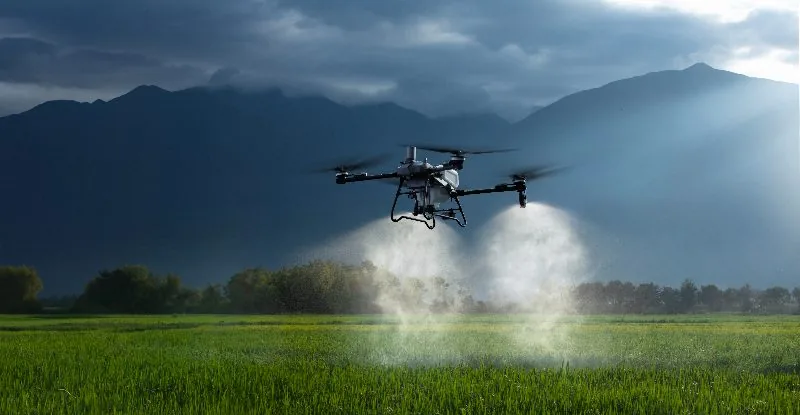
For decades the boom sprayer has been the backbone of crop protection on farms. Rising fuel costs, soil compaction and difficult weather are now leading more and more farmers to consider drones.
A drone will not replace a sprayer in every situation, but at several key points in the season it has the edge. Here is a detailed comparison.
Comparison: boom sprayer vs drone
| Parameter | Boom sprayer | Agricultural drone (Agrodron) |
|---|---|---|
| Wheel-track losses | depends on the field – greatest with late passes and without permanent tramlines | none – the drone does not touch the soil |
| Spray volume | 200–300 l/ha | 10–30 l/ha (depending on the product label) |
| Wet field | often impossible – ruts, getting bogged down | yes – flies over the crop, no need to enter the field |
| Tall crop (maize, oilseed rape) | limited – risk of crop damage | yes – flies over the crop |
| Soil compaction | yes – compaction of the topsoil | no |
| Difficult and irregular fields | restricted access | quick access, zone-specific application possible |
Main advantages of drone application
1. No crop losses and better protection of soil structure
A pass with heavy machinery means crushed plants in the wheel tracks and compacted soil. A drone works without contact. Application is from the air, so the whole crop stays in the field and the soil is not compacted.
2. Working when you cannot get onto the field
After heavy rain a sprayer has to wait, while fungal diseases and pests keep developing. A drone does not need dry ground, so the job can go ahead at the planned time, weather permitting.
3. Savings on water and fuel
A drone typically uses 10–30 litres of liquid per hectare. The airflow from the rotors moves the leaves, which helps coverage of the undersides too.
Rules and permissions
When does a sprayer still make sense, and when should you combine both methods?
When the sprayer wins: on very large, regular fields and for jobs needing a large volume of liquid, a boom sprayer can work out cheaper per hectare.
Combined approach – the best results: many farms use a sprayer for early treatments while the field is passable, and a drone for:
- crop treatments in tall maize and oilseed rape, where permitted,
- foliar applications when fields are too wet for machinery after rain,
- spot applications on hard-to-reach or irregularly shaped plots.
See also: how much drone services cost i how the rules apply to plant protection products and drones.
FAQ – frequently asked questions
How much yield do I lose to sprayer passes?
It depends on the crop, the growth stage and whether the field has permanent tramlines. Wheel damage is greatest with late passes in oilseed rape and tall maize, and on fields without permanent tramlines. On fields with tramlines it is small.
Can a drone work after rain?
For the flight itself, yes. A drone does not drive onto the field, so wet soil is not an obstacle. Note that in Great Britain, aerial application of plant protection products requires an aerial application permit from HSE (Chemicals Regulation Division), which covers specific products, crops and situations. For work that does not involve plant protection products, such as spreading fertiliser or seeding cover crops, wet ground is not a problem.
When is a boom sprayer cheaper?
On very large, regular fields and for jobs needing a large volume of liquid. Combining both methods gives the best results.
Request a drone application for your farm
Support your yield, save time and cut crop damage from machinery passes. See how precise applications from the air can be.
Request a quote